“I switched my geyser off for two years. The bill never moved.”
Elsabé van Wyk (68) did everything we’re all told to do: the timer, the blanket, the 5 a.m. showers. Her account still said R3 812. Then her neighbour showed her what Japanese homes have had since 1958.
 By Karin Steyn, Consumer reporter30 Oct 2026 · 6 min read

Elsabé van Wyk has lived in the same face-brick house in Moreleta Park, Pretoria, for 31 years. She and her husband Kobus (72) paid off the bond in 2009. They have never missed an account.
“We’re not wasteful people,” she tells me at her kitchen table. “We grew up being careful. So when the electricity started going up every year, we did exactly what everybody tells you to do.”
She is talking, of course, about the geyser.
“We did everything they told us”
You’ve heard it too: the geyser is up to 40% of your bill. It’s on the radio, on the municipal leaflets, on the clipping Elsabé still has stuck to her fridge.

So the Van Wyks went to work on it. One by one, over two years:
- A timer on the geyser: two hours in the morning, nothing else.
- The thermostat turned down from 65°C to 55°C.
- A geyser blanket. Kobus climbed into the roof himself to fit it. “At 70. I was terrified he’d fall through the ceiling.”
- 5 a.m. showers, to catch the hot water before the timer switched off.
- Kettle baths in winter, when the water ran out.
- The geyser off completely for most of the day, breaker down at the DB board.

“And every month I stood at that keypad and waited for it to get better,” she says. “It never did.”
“Cold showers are brutal for old people”
Elsabé says the money was only half of it.
“You start living around the geyser. You set an alarm to shower. You boil the kettle four times to wash. You lie awake doing sums: two pensions, the medical aid, the rates, and the electricity eating more of it every year. We didn’t tell our children. You don’t want them to worry, and you don’t want to be the parents who need the R500.”

Cold showers are brutal for old people. Nobody tells you that when they say switch it off.
Elsabé van Wyk, 68
Then came July, and the new tariffs. “Same house, same two people, same geyser routine. And the units went even faster. That’s when I really started to feel stupid. I’d done everything right.”
The night she stood at the DB board
The turning point was a Tuesday night in winter, a little after ten.
“The geyser breaker was down. I’d checked it twice. The kettle was off, the stove was off, the lights were off except the passage. And I looked at the keypad and it was still going down. Not a little. I watched it for half an hour.”
“I said to Kobus, if the geyser is off, what on earth is eating our units?”
Nobody at the municipality could tell her. The electrician who came out said the wiring was fine and the meter was fine. “He told me to put the geyser on a timer,” she laughs. “I showed him the timer.”
What Linda next door said
The answer came over the garden wall.
Her neighbour Linda (71) has the same 1990s house, the same size family, the same kind of geyser. “We were moaning about the July increase like everybody,” Elsabé says, “and she said, quite casually, that her account was about R600 now. I thought she was joking. Ours was R3 800.”

Linda hadn’t switched anything off. She hadn’t bought solar. She’d done one thing: plugged in a small device her son-in-law had read about, made with technology from Japan.

Why the geyser was never the problem
The device was developed by Hiroshi, an electrical engineer from Osaka who moved to South Africa. His first bill here gave him a fright: R3 800 for a flat in Johannesburg. His parents in Osaka pay about R540 for a home the same size.

So he started measuring. He tested 100 homes in Johannesburg, and found the same thing in almost every one:
Engineers call it reactive power. Hiroshi calls it dirty electricity. And here is the part that changed everything for Elsabé:
A geyser doesn’t make it. A geyser element is a simple heating coil. Every unit it draws turns into hot water. It is the cleanest thing in your house.
The dirty electricity comes from the things that never switch off: the fridge and freezer compressors, the pool pump, the TV decoder, the chargers, the motor in every appliance. They push power back and forth through your wiring 24 hours a day, and your meter counts every bit of it as if you’d used it.

“That’s why the keypad kept going at ten o’clock at night,” Elsabé says. “It was never the geyser. It was the old fridge in the garage, humming away all night, and me paying for it three times over.”
It also explains why the timer, the blanket and the cold showers barely moved her account. They all worked on the geyser, and the geyser was never where the money was leaking.
In Japan this was settled in 1958: power companies are not allowed to charge households for dirty electricity, and homes correct it at the plug. In South Africa there is no such rule. The meter counts it, and you pay.
So what is VoltGuard™?
Hiroshi’s device is called VoltGuard™. It is a power factor corrector, the same technology Japanese homes use, made small enough to plug into a normal South African wall socket.
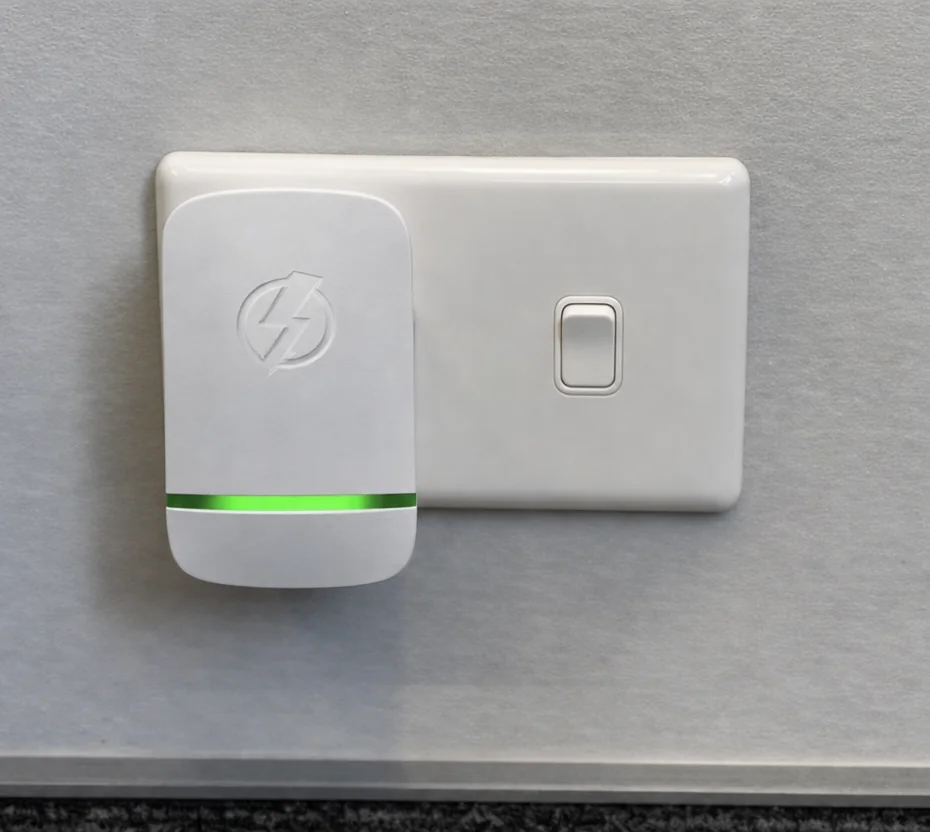
It supplies that back-and-forth power right there at the plug, so it stops running through your meter. The meter is left counting what you actually use.
- Plugs into any wall socket. No electrician, no installation.
- Never touches your meter. Nothing is opened, changed or tampered with, so there’s nothing to register and nothing to be fined for.
- Works 24/7 on the whole house, including the fridge and freezer.
- No solar, no new geyser, no loan, no subscription.
- Change nothing. Keep your habits, or go back to normal ones.
“Switch it back on. Let’s see.”
Elsabé is not a woman who believes things easily. “I’ve seen the adverts for those cheap boxes. I thought it was another one.” So she did what she’d done for two years: she wrote it down.
Every morning at seven she copied the keypad reading into a school exercise book. A week without the device. Then she plugged VoltGuard™ in next to the kitchen fridge, changed nothing else, and kept writing.
Then Kobus did something that frightened her: he went to the DB board and put the GEYSER breaker back up. For good.
“He said, switch it back on, let’s see. I nearly had a heart attack.”

Their next full month, with the geyser on 24 hours a day for the first time in two years:
They have since put a second one in, by the DB board. “One for the kitchen with the fridge, one for the rest of the house. That’s what Linda has too.”
Hiroshi’s own numbers are bigger. His tests saw savings of up to 91%, depending on how many appliances a house runs. “I don’t care about the percentage,” says Elsabé. “I care that I stopped doing sums at night.”
Don’t believe it. Check it on your own meter.
This is the part Elsabé wants every reader to hear, and the reason she agreed to this story.
- 1Tonight, write down your keypad reading (or your meter number) and the time.
- 2Plug VoltGuard™ in next to the fridge. The green light comes on. Change nothing else.
- 3After 7 days, compare. Then switch the geyser back on and watch what happens.
You have 60 days to see it on your own meter. If your units don’t last longer, send it back and get every cent of the purchase price back.
- One rule: your units last longer, or your money comes back
- Free delivery anywhere in South Africa
- Secure card payment
Readers who tried it

Ten years of turning the geyser off at the DB board. My wife made me try this. Units went from lasting ten days to lasting the month, and the geyser is back on. I owe her an apology.

I used to buy R200 of points and it was finished before the weekend. Now the same R200 lasts me nearly two weeks. My son put it in for me in two seconds.

I live alone in a retirement cottage and my account was R1 900 with nobody here half the day. It is under R700 now. I wrote the readings down like the lady in the article. The numbers don’t lie.


 38
 12
 21
 17
 2
 5